Combatting Financial Exclusion of the Elderly in the Digital Age - A Regulatory Roadmap
A regulatory roadmap for mitigating the financial exclusion of the elderly in the era of financial services digitisation.
The project focuses on the growing problem of financial exclusion among the elderly, particularly in the context of the rapidly advancing digitisation of financial services. As financial institutions increasingly move their services online, older persons, who frequently face challenges related to digital literacy, declining cognitive abilities, and access to technology, are at risk of marginalisation. The project aims to examine the impact of this digital transformation on the ability of older persons to avail themselves of financial services – such as making payments for goods and services – which is crucial for their independence and wellbeing.
The project addresses a distinct gap in the current state of research. Most existing work on financial inclusion treats consumers as a homogeneous group, failing to account for the specific needs of various demographic groups, particularly the elderly. This is problematic because older persons face unique challenges in using digital financial services. These challenges include lower levels of financial literacy, difficulties in adapting to new technologies, and age-related cognitive limitations. As a result, seniors are often excluded from access to essential financial services, which undermines their ability to live independently and participate fully in society.
To date, legal research on financial inclusion has focused on already digitally engaged consumers, overlooking those who are involuntarily excluded due to barriers such as a lack of digital literacy or access to technology. Furthermore, a more interdisciplinary approach combining legal, sociological, and economic perspectives is needed to better understand the implications of digital exclusion. The project fills this gap by focusing specifically on older persons and proposing legal reforms that will ensure their inclusion in the digital financial ecosystem.
The ultimate goal of the project is to develop a regulatory roadmap that will help ensure that older persons are not left behind in this transformation. This roadmap will encompass the legal, economic, and social aspects of digital exclusion, proposing a concrete regulatory framework that can help counteract financial exclusion and promote inclusiveness within the financial sector. It will assess the potential for public and private law intervention, focusing on how regulations can be designed to protect vulnerable consumers – particularly older persons who find it more difficult to adapt to digital financial services.
The research is underpinned by empirical findings highlighting the susceptibility of the elderly population to financial exclusion due to lower levels of digital literacy, cognitive limitations, and lack of access to technology. The primary research objective is to ascertain how legal and regulatory frameworks can be reformed or designed to ensure the financial inclusion of older persons. The project spans multiple disciplines, including law, sociology, and political economy, as well as a comparative study of legal systems in various countries, such as the USA, EU Member States, and the United Kingdom. The comparative approach will illuminate the global dimension of this issue.
Work plan
The project is structured into five work streams implemented over a 36-month period. The first phase focuses on empirical research — qualitative interviews with seniors in various regions of Poland. These interviews will provide valuable insights into the real experiences of older adults facing barriers to accessing digital financial services. Empirical data will be collected through in-depth interviews in urban and rural environments, ensuring broad demographic representation.
In the second phase, the project will transition to non-empirical research — an analysis of the legal frameworks governing financial services in several jurisdictions, including the USA, the EU, and key member states such as Poland, France, and Germany. The legal analysis will be conducted using classical legal scholarly methods — dogmatic and comparative legal — to identify gaps and opportunities for reform. The results of the empirical research will be used to inform this analysis and verify the project's main hypotheses regarding the need to develop regulatory frameworks to counteract the financial exclusion of older persons.
Planned activities
During the project, several key events supporting the execution of empirical and non-empirical research tasks have been planned. In Phase 1, the project team will conduct interviews with seniors in four locations across two regions of Poland. These locations will offer diversity: large cities, medium-sized towns, small localities, and villages, to capture the variety of experiences within the elderly population.
Additionally, the project involves numerous research visits to renowned academic centres, enabling in-depth legal analysis and consultations with other researchers. These visits will provide an opportunity to present preliminary results and engage in exchanges with global experts in the field.
Project publications
The project will generate a significant number of prestigious academic publications which will contribute both to legal scholarship and to interdisciplinary achievements.
- Anne-Marie Weber, Weronika Herbet-Homenda, Helena Kordasiewicz, Unveiling Digital Exclusion Among the Elderly: Gaps in Knowledge and Methodology, [in:] D. Damar-Blanken, M. Kelly-Louw (eds.), Financial Inclusion Law and Over-Indebtedness, Routledge 2025, pp. 27–44.
Conference presentations
During the project’s realisation, the research team shall present its findings at various academic conferences, ensuring their wide dissemination and obtaining feedback from the academic community. Research outcomes shall be presented at no fewer than five significant conferences in Poland in order to involve the national academic community and decision-makers in the discussion. Findings shall also be presented during workshops and round-table discussions organised by leading academic centres, which will create further opportunities for consultation and cooperation.
- 01
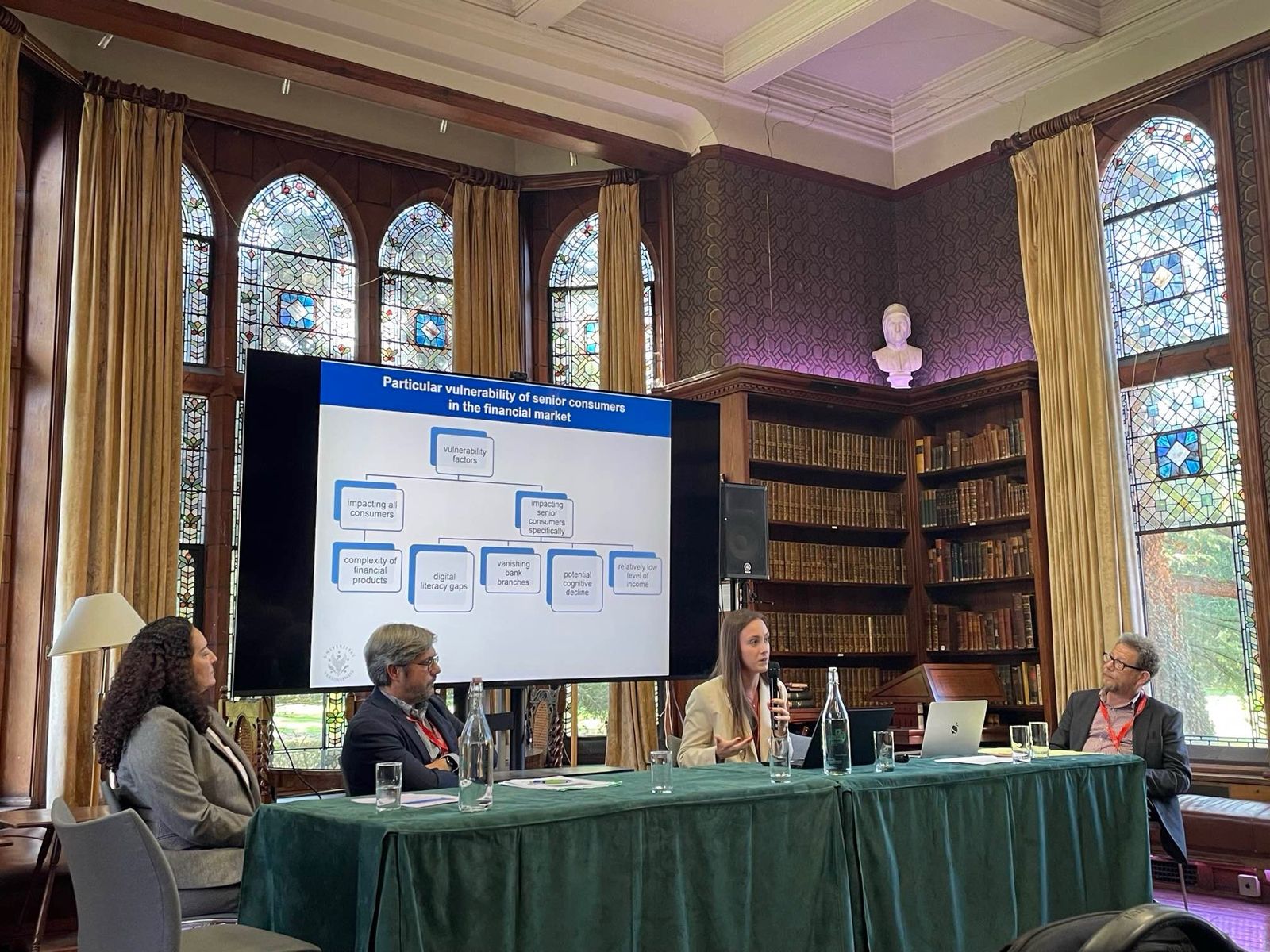
1st European Conference of the International Association of Consumer Law (IACL), Girton College, University of Cambridge, 16–17.09.2024
As part of the panel "Over-Inclusion, Under-Protection and Targeting – Responses to Discrimination, Inequality and Exclusion in Financial Services", Weronika Herbet-Homenda presented a paper entitled "Consumer Vulnerability in Financial Markets: Special Protection of the Elderly", prepared jointly with Anne-Marie Weber. Both the presentation and the subsequent discussion focused on the challenges associated with the particular susceptibility of seniors in financial markets and various related risks, as well as on information obligations as an exemplary remedy useful in counteracting market exclusion.
- 02
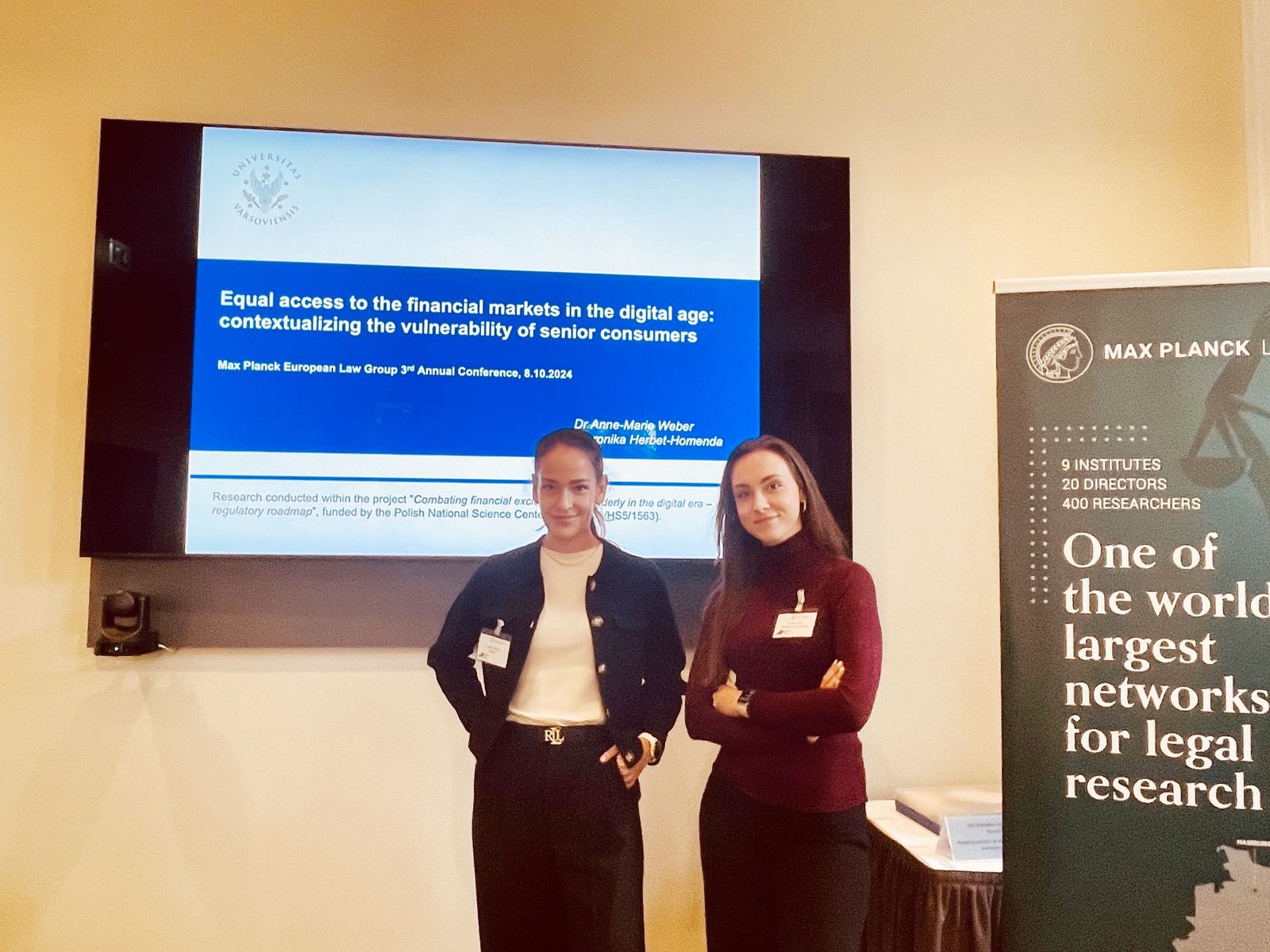
3rd Max Planck Law Group, Berlin, 8 October 2024
On 8 October 2024, Dr Anne-Marie Weber and Weronika Herbet-Homenda presented their paper "Equal access to the financial markets in the digital age: contextualizing the vulnerability of senior consumers" at the 3rd Max Planck European Law Group in Berlin.
- 03
II International Conference on Business Law, 4 April 2025
As part of the student and doctoral panel "Sustainability", Hanna Salera presented a paper entitled "Leave No-One Behind: Fostering Financial Inclusion of the Elderly in Light of the SDGs." The presentation analysed the challenges associated with the financial exclusion of older persons and the need to include them in sustainable development policies, in line with the 2030 Agenda and the Sustainable Development Goals (SDGs). The presentation, as well as the accompanying discussion, covered, among other things, the role of financial institutions in counteracting exclusion, mechanisms supporting inclusiveness, and the need to adapt financial services to the specific needs of seniors.
- 04
IX International Scientific Conference "Protection and Security in the Financial Market", 22 May 2025
On 22 May 2025, Dr Anne-Marie Weber delivered a paper entitled "Covering financial institutions with public policy on financial education - a gap in the National Financial Education Strategy for Poland?" at the IX International Scientific Conference "Protection and Security in the Financial Market", organised at the University of Łódź in cooperation with the Wrocław University of Economics.
The presentation took place within Session I and addressed a significant gap in policy regarding the inclusion of financial institutions in Poland's public financial education strategy. The analysis focused on the need for coordinated regulatory action increasing institutions' involvement in building financial literacy and consumer protection.
The conference gathered experts from over a dozen countries, offering parallel sessions in Polish and English. Topics included fraud prevention, AI in financial services, sustainable finance, ESG policy, and the role of central banks.
- 05
II International Scientific Conference "Finance and New Technologies – Legal and Economic Aspects", 23 May 2025
On 23 May 2025, Weronika Herbet-Homenda delivered a presentation entitled "Risk of financial exclusion of the elderly in the digital age and the protection of vulnerable consumers" at the II International Scientific Conference "Finance and New Technologies – Legal and Economic Aspects", organised in a hybrid format in Opole.
The presentation was part of Panel III: New Technologies in Banking. The presentation addressed the growing risk of financial exclusion faced by older consumers in the era of digital transformation and analysed legal mechanisms aimed at protecting vulnerable clients in the financial services market.
The conference brought together academic and professional experts from across Europe, offering a platform for discussion at the intersection of finance, law, and new technologies. Weronika Herbet-Homenda's contribution underscored the importance of inclusive policy and regulatory approaches in the face of the rapid digitalisation of the banking sector.
- 06
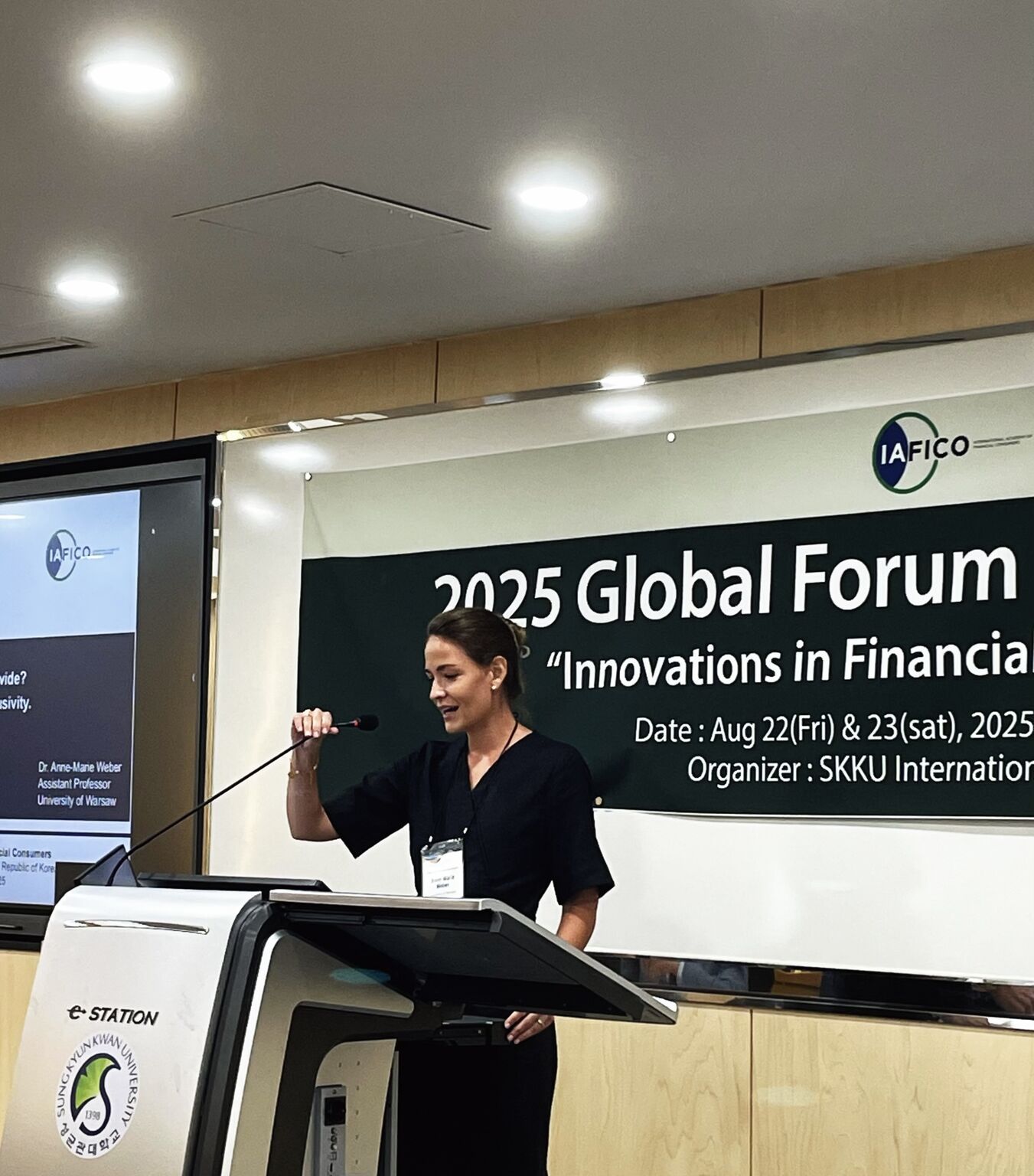
2025 Global Forum for Financial Consumers (GFFC), 22–23 August 2025, Sungkyunkwan University, Seoul, Republic of Korea
Dr Anne-Marie Weber presented a paper entitled: "Bridging or Widening the Digital Divide? The Digital Euro and Financial Inclusivity."
- 07
III International Scientific Conference "Finance and New Technologies – Legal and Economic Aspects", 15 May 2026
On 15 May 2026, two team members participated in the III International Scientific Conference "Finance and New Technologies – Legal and Economic Aspects", organised in a hybrid format in Opole. During the first panel, dedicated to global and cross-border FinTech challenges, Dr Robert Rybski delivered a presentation entitled "Human Rights Approach Towards Exclusion of the Elderly in Modern Digitalized Finance". Weronika Herbet-Homenda presented a paper "How can the law protect older people from financial exclusion? A case study from the UK." in the panel on sustainable finance and the future of financial markets.
- 08
EU Savings and Investments Union: A Key to Further Integration of the EU Banking and Capital Markets System?, 27–29 May 2026
Dr Anne-Marie delivered a paper entitled "EU Retail and Investment Strategy and EU Financial Literacy Strategy" at the conference "EU Savings and Investments Union: A Key to Further Integration of the EU Banking and Capital Markets System?", which took place on 27–29 May 2026. The presentation discussed the latest changes in EU law, opening an academic discussion on the role of the financial sector and the limits of limited, supply-side regulatory interventions combined with soft educational governance.
Project team
 Project Leader
Dr Anne-Marie Weber LL.M. (Berkeley)
Anne-Marie Weber is an Assistant Professor in the Department of Commercial Law at the University of Warsaw, where she defended her doctoral dissertation, subsequently awarded by the Chairman of the Polish Financial Supervision Authority in a competition for the best doctoral thesis in the financial market field and published as a monograph entitled „Wpływ instytucji prawnych rynku kapitałowego na efektywność spółek Skarbu Państwa”. She holds a Master of Laws (LL.M.) degree from Berkeley School of Law. She lectures on company law and financial market law and is a lecturer at the School of German Law operating at the Faculty of Law and Administration of the University of Warsaw. Dr Anne-Marie Weber is a frequent Visiting Scholar at the Max Planck Institute for Comparative and International Private Law in Hamburg. She has also served as a Visiting Professor at Berkeley School of Law and the University of Mainz. She has received numerous scholarships and research grants, including from the French government (Campus France), Max Planck Gesellschaft, and the National Science Centre. Her habilitation thesis, currently in preparation, addresses the issue of implementing and enforcing climate policy goals through private law institutions, primarily company law.

Dr Robert Rybski
Robert Rybski is an Assistant Professor at the Faculty of Law and Administration at the University of Warsaw, where he also serves as the programme director for "Sustainable Finance – Postgraduate Studies in Law and Finance" and the supervisor of the Environmental Law Student Research Group. In 2018, he defended his doctoral dissertation on nuclear energy in Germany at the intersection of German constitutional law, energy law, and environmental law. He is a graduate of law at the University of Warsaw, holds an LL.M. from Humboldt-Universität zu Berlin, completed the Sustainable Finance Executive Programme at the University of Oxford, and the International School in Nuclear Law at the University of Montpellier. Dr Rybski lectures on sustainable finance, constitutional law, and new technologies. Coming from a civil society background, he worked at the Office of the Commissioner for Human Rights, the Ludwig Boltzmann Institute of Human Rights, the ClientEarth Poland Foundation, and the Helsinki Foundation for Human Rights. For nine years, he served as an Expert in the Infrastructure and Trading Department of the Polish Financial Supervision Authority (KNF), where he was also the Polish Delegated National Expert in the EU Commodity Derivatives Task Force (CDTF) at the European Securities and Markets Authority (ESMA) and in IOSCO Committee 7 on derivatives.
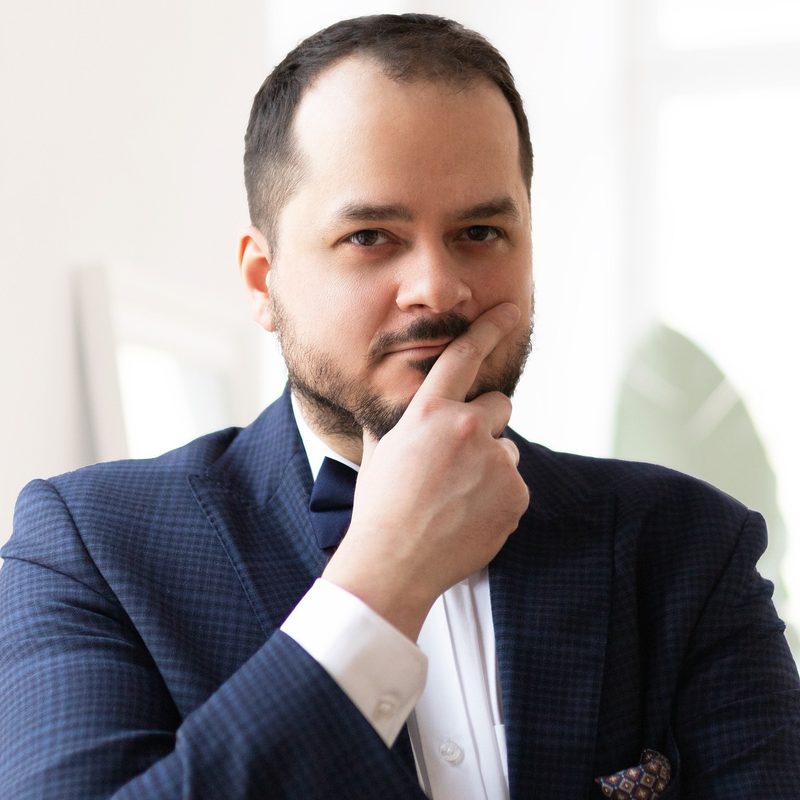
Dr Paweł Maranowski
Paweł Maranowski is a sociologist, lecturer at Civitas University, Chief Expert for Research and Analysis at the Educational Research Institute – National Research Institute, and a member of the team conducting the national PISA 2025 study in Poland. From 2019–2025, he served as Vice-Rector for Student Affairs at Collegium Civitas; from the current academic year, he is associated with the Faculty of Law and Administration at the University of Warsaw, where, as an expert on research methodology, he participates in teams implementing the projects "International Sanctions Evasion through Central Bank Digital Currencies" and "Combatting Financial Exclusion of the Elderly in the Digital Age – A Regulatory Roadmap". His academic interests focus on political sociology, sociology of law, political psychology, and especially social research methodology, survey research, and quantitative and qualitative data analysis. Selected publications: The Judiciary Elite in the Third Polish Republic at the Beginning of the Transformation and Destabilisation Process, 2022; Worldview Polarisation of Polish Society and Social Classes and Strata (with A. Przestalski and P. Ruszkowski), 2020; Social Worlds of the Governmental Administrative Elite, 2016; The Role of Social Innovations in Polish Universities, 2016; State Administrative Elites in Law-Making Processes, 2015.
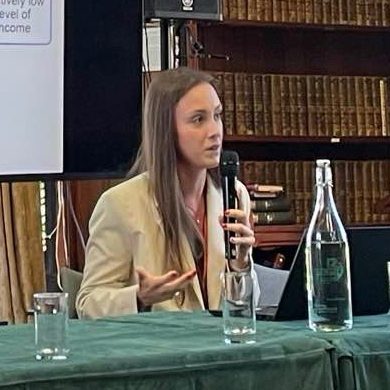
Weronika Herbet-Homenda
Weronika Herbet-Homenda is a doctoral candidate in the Department of Commercial Law at the Faculty of Law and Administration, University of Warsaw; an associate at BWHS Wojciechowski Springer i Wspólnicy sp.k. She specialises in competition law, consumer protection, and company law, focusing her research on issues at the intersection of these areas, including antitrust liability in capital groups and consumer protection in digital markets.
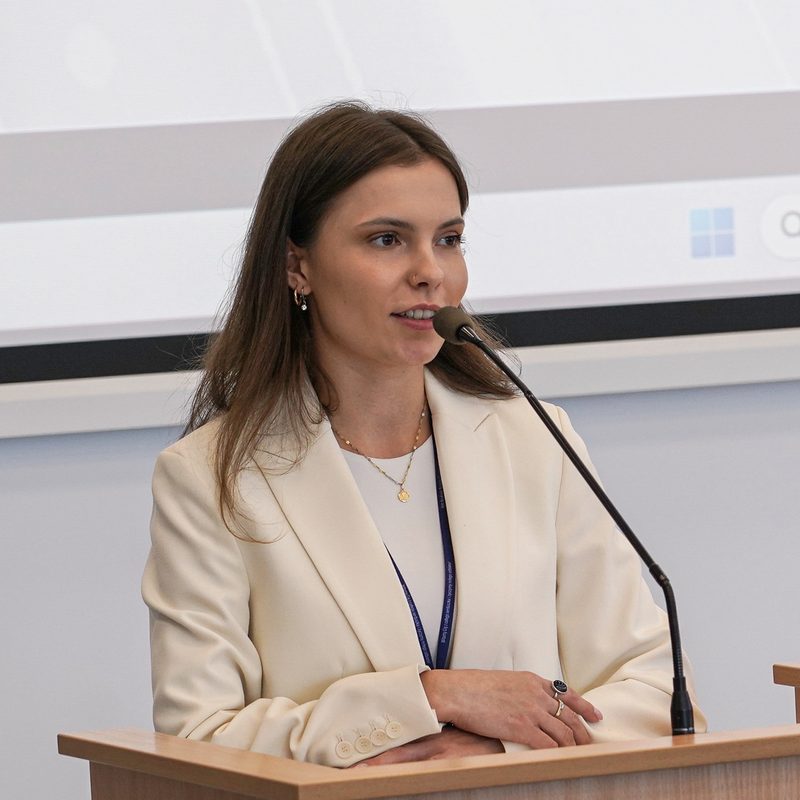
Hanna Salera
Hanna Salera is a third-year law student at the University of Opole, where she also completed her Bachelor's degree in Business Service. Actively involved in academic activities, she serves as President of the Student Scientific Circle dedicated to financial markets. Currently, she works as a Legal Assistant at GP Legal & Partners law firm, gaining practical experience in the legal field. Her main areas of interest include capital market law, medical law, and business law.
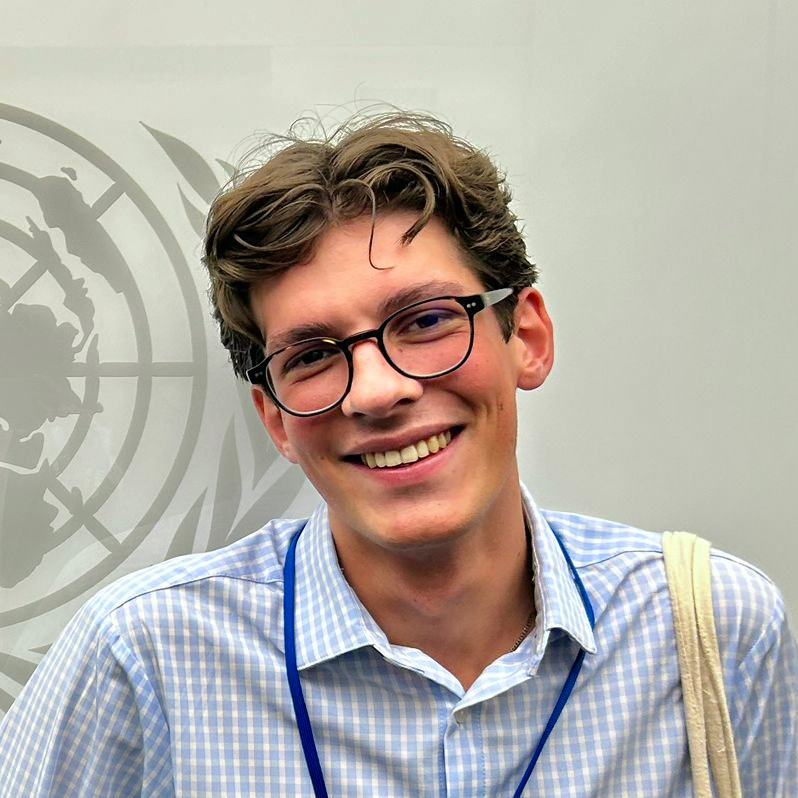
Tymoteusz O’Neill
Tymoteusz O’Neill is a recent graduate of law from the University of Warsaw. From January to May 2025, he served as the UN Representative for the International Federation for Family Development in New York. During this period, he developed an interest in the rights of older persons and dedicated his Master's thesis to the protection of the rights of older persons in international law. He also served as President of the Colloquium Legale Student Research Group; he published articles in the field of antitrust law and agricultural law. His interests include human rights, constitutional law, and administrative law.

Iga Kupiec
Iga Kupiec is a third-year undergraduate student of sociology with a specialisation in criminology at Civitas University in Warsaw. She is actively involved in the Student Scientific Circle of Sociology, where she serves as Vice-President, and in the Crimen Student Scientific Circle of Criminology, of which she is President. Within the Sociology Scientific Circle, she participated in the social campaign "Stop Znieczulicy na Ulicy" (Stop Indifference on the Street), for which she co-created educational content explaining phenomena related to the campaign's theme from a sociological perspective. Her main academic interests include social stratification and the sociology of deviance and social control.

Aleksandra Madejska
Aleksandra Madejska is a fifth-year law student at the University of Warsaw. Her academic work focuses on administrative law, and she actively participates in academic conferences. She is a board member of the Student Scientific Circle of Philosophy of Law and Social Philosophy. She has several years of professional experience. She works as an Inspector in the Department of Legislation and Public Affairs at the General Counsel to the Republic of Poland. Her main areas of interest are administrative proceedings and the applications of technology in law.