The role of sustainable corporate governance for EU climate policy
The Role of Corporate Governance in the Transformation to Sustainable Capitalism – in the Light of the European Green Deal and the 2030 Agenda.
In light of the latest evidence from the natural sciences, climate change caused by human activity is increasingly understood as the defining global challenge of our era. This has initiated a profound process of socio-cultural transformation – the sustainability revolution – which challenges many fundamental principles of organising economic activity.
In particular, existing perceptions of the role of corporations in society are being questioned. Climate policy ranks high on contemporary global political agendas. International commitments, such as the Paris Agreement and the UN 2030 Agenda for Sustainable Development, set the global direction for sustainability policy. In the EU—in addition to Treaty obligations—the European Green Deal and its declaration of climate neutrality provide a roadmap for action.
Corporations naturally find themselves at the centre of legislators' attention. Their pivotal role in mitigating climate change—through reducing net emissions and driving the innovation and adaptation essential for achieving a net-zero economy—is widely recognised. In the search for adequate policy mechanisms, the question of the role of corporate governance in the aspired transformation towards sustainable capitalism becomes particularly pertinent.
While public law instruments—e.g., direct emission regulations or market-based solutions—have a long tradition as tools of environmental policy, the latest trends increasingly emphasise the role of private law, especially company law, in implementing sustainability policy objectives. Essentially, the aim is to more strongly commit companies to achieving sustainability goals. The question thus arises whether company law institutions can transform corporate governance frameworks to align corporate conduct with climate policy objectives. "Corporate sustainability" is the banner under which this evolving debate sails.
Research Subject and Research Gap. The project addresses the challenge of the sustainable reorientation of economic activity. It examines how climate policy objectives can be supported through the design of private law (company law) institutions shaping corporate governance.
Work plan
The general hypothesis of the project assumes that the regulation of corporate governance mechanisms through company law—if appropriately structured—can play a crucial role in catalysing EU climate policy. Drawing on law & political economy and institutional economics literature, the project identifies the constitutive role of legal institutions in shaping corporate behaviour. A redefinition of the corporate purpose is fundamental, as it determines the duties of the company's residual decision-makers—i.e., the members of its governing bodies—and thereby directly influences its conduct. The verification of the general hypothesis will be carried out by testing seven sub-hypotheses that define the project's specific research questions.
In the first step, the project will identify the current legal status of corporate sustainability and, at a granular level, examine the theoretical foundations relating to the sources of power and the normativity of corporate sustainability reform. These findings will serve as initial material for designing qualitative and quantitative research.
The next task is to collect empirical data. The team will analyse a representative number of publicly available statutes of listed companies in the jurisdictions covered by the study and their annual non-financial reports, and will select companies for in-depth qualitative case studies. To capture how SMEs understand their purpose in terms of sustainability, online surveys will be conducted targeting predefined groups of respondents. The empirical research will also include in-depth interviews with policy makers.
The subsequent task will involve the analysis and interpretation of the collected data, enabling verification of the project's sub-hypotheses. It is also planned to consult these findings with eminent experts in the field.
Achieving the scientific objective of the project should result in a series of prestigious academic publications aimed at a wide audience of scholars, including academics from law and political science disciplines.
Planned activities
The list of planned events will be updated on an ongoing basis.
Project publications
The list of publications will be updated on an ongoing basis.
- Corporate Due Diligence and Corporate Accountability - remedying environmental damage in a transboundary context [in:] S. Dudzik, A. Sikora, B. Iwańska (eds.), Cross-border pollution and environmental disputes in EU Law. Global challenges and local remedies, Routledge 2025 (forthcoming) (K. Oplustil, A-M. Weber)
- The interest of the company in the context of sustainable development postulates – a polemic, Przegląd Prawa Handlowego, 2025/7 (Anne-Marie Weber).
- Corporate due diligence as an element of sustainable corporate governance - the CS3D directive and its impact on corporate duties and liability, Przegląd Prawa Handlowego, 2024/11, pp. 4-18 (K. Oplustil, A-M. Weber).
- Expanding the Toolbox of Sustainable Business Law: The Transnational Impacts of the EU Corporate Sustainability Due Diligence Directive (CSDDD), Pace Environmental Law Review, 2024/1, pp. 155 - 181 (Anne-Marie Weber).
- Sustainable corporate governance all'italiana, Przegląd Prawa Handlowego, 2022/10, pp. 30-39 (Z. Mazur, A-M. Weber).
- Sustainable corporate governance en français, Przegląd Prawa Handlowego, 2022/7, pp. 15-23 (A. Szczęsna, A-M. Weber).
- Sustainable corporate governance – a direction for the evolution of Polish company law?, Przegląd Prawa Handlowego, 2022/6, pp. 20-33 (Z. Mazur, A. Szczęsna, A-M. Weber).
Conference presentations
- 01
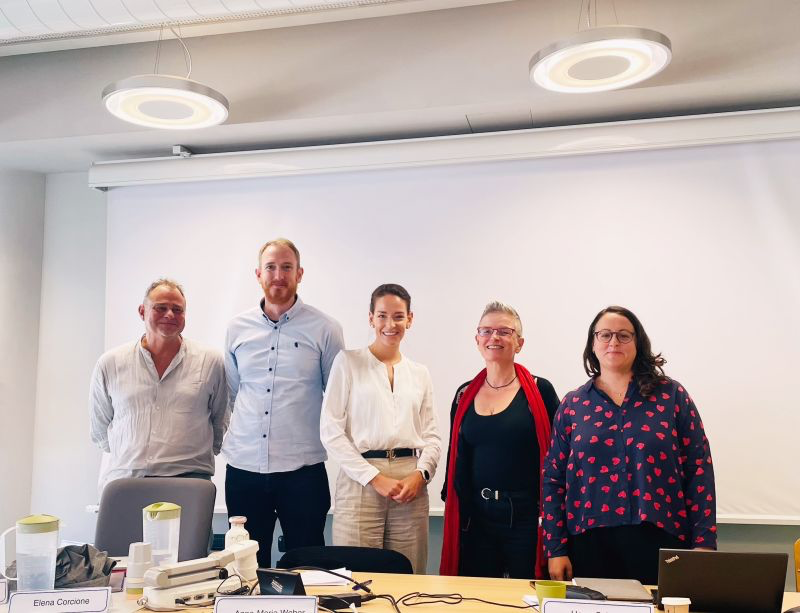
SMART Network Symposium, Università degli Studi di Torino, 19 September 2025
On 19 September 2025, Dr Anne-Marie Weber delivered a paper entitled "Advancing Sustainable Corporate Governance in the EU Capital Markets Union" at the SMART Network Symposium "Sustainability is (Still) Possible! Governing Market Actors for a Safe and Just Space" hosted by the Università degli Studi di Torino. Dr Anne-Marie Weber also participated in a panel with Beate Sjåfjell, John Quinn, and Elena Corcione, moderated by Harm Schepel.
- 02
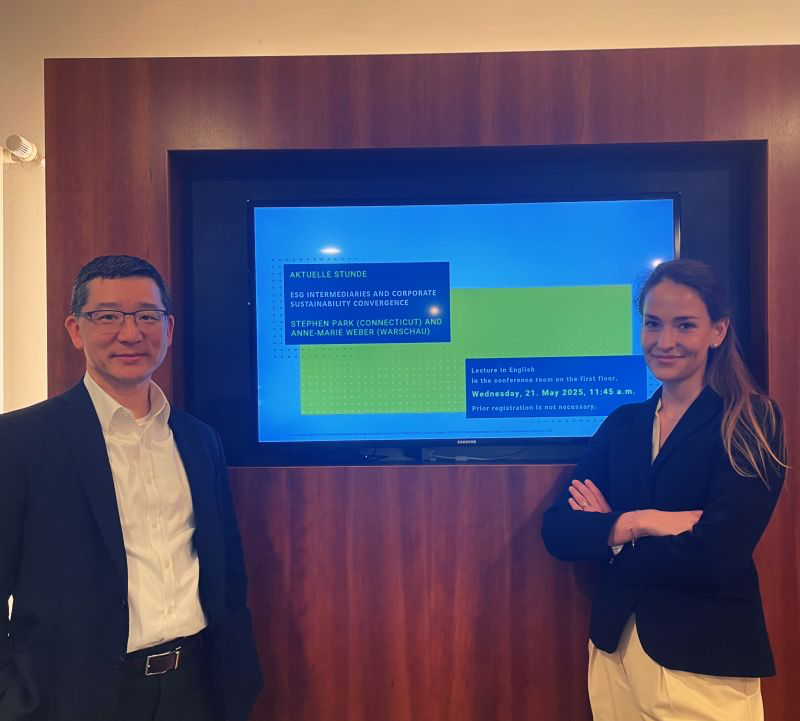
Max-Planck-Institut für ausländisches und internationales Privatrecht, 21 May 2025
On 21 May 2025, Dr Anne-Marie Weber, together with Stephen Park (University of Connecticut School of Business), presented the work-in-progress paper "ESG Intermediaries and Corporate Sustainability Convergence" during "Aktuelle Stunde" at the Max-Planck-Institut für ausländisches und internationales Privatrecht.
- 03
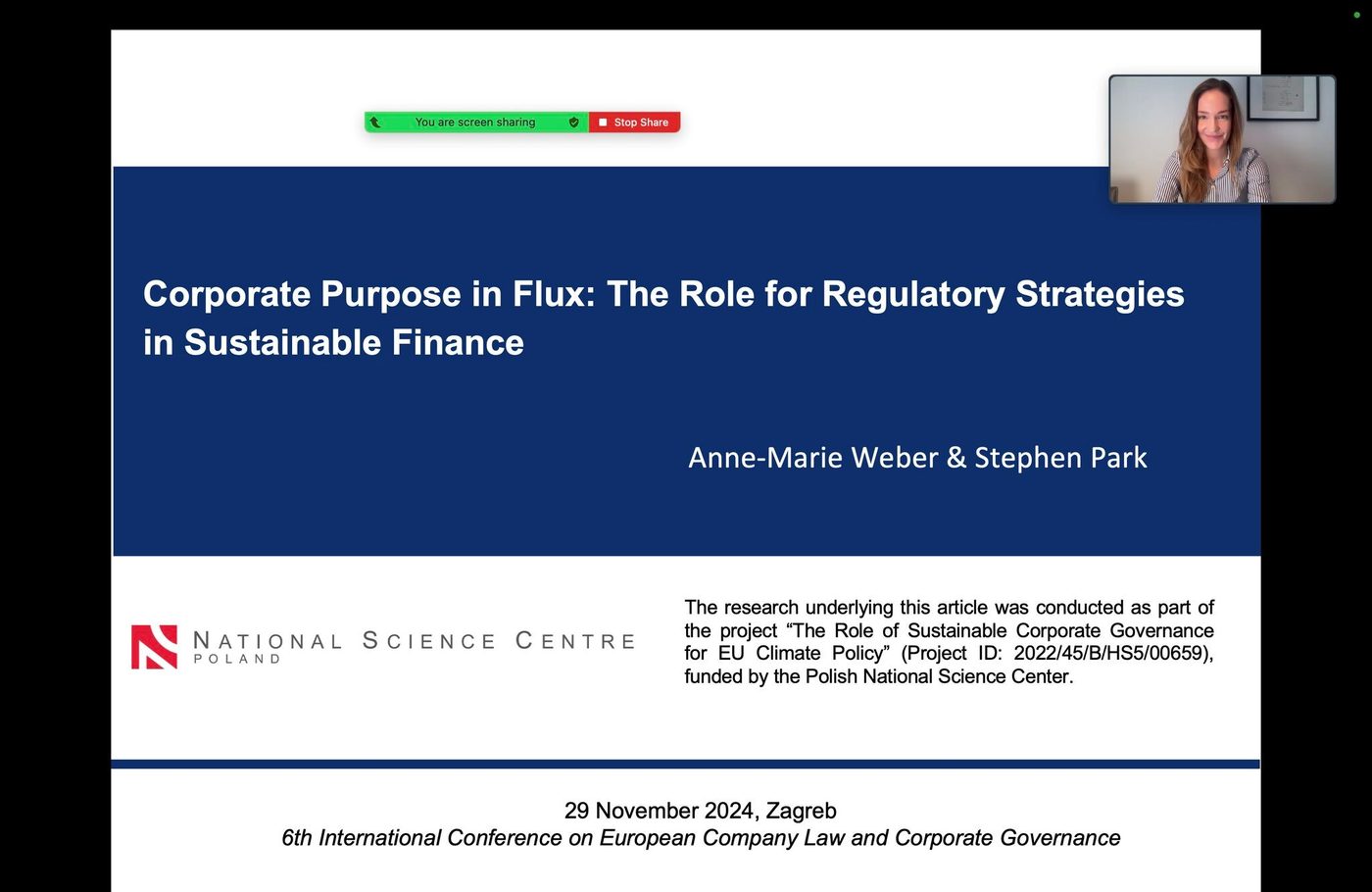
6th International Conference on European Company Law and Corporate Governance, Zagreb, 29 November 2024
On 29 November 2024, Dr Anne-Marie Weber presented a joint research paper entitled "Corporate Purpose in Flux: The Role for Regulatory Strategies in Sustainable Finance", prepared with Stephen Park (University of Connecticut School of Business), during the 6th International Conference on European Company Law and Corporate Governance "New Era in Corporate Governance: Sustainability at Crossroads". The event was organised by the Faculty of Economics & Business in Zagreb.
- 04
Yunus Social Business Centre Conference, Alma Mater Studiorum – Università di Bologna, 3 November 2023
On 3 November 2023, Dr Anne-Marie Weber and Aleksandra Szczęsna presented a paper entitled "FinTech & ESG – Marriage of buzzwords, or compelling policy avenue for sustainable development?" during the Yunus Social Business Centre Conference on Sustainable and Socially Responsible Finance 2023, hosted by Alma Mater Studiorum – Università di Bologna.

- 05
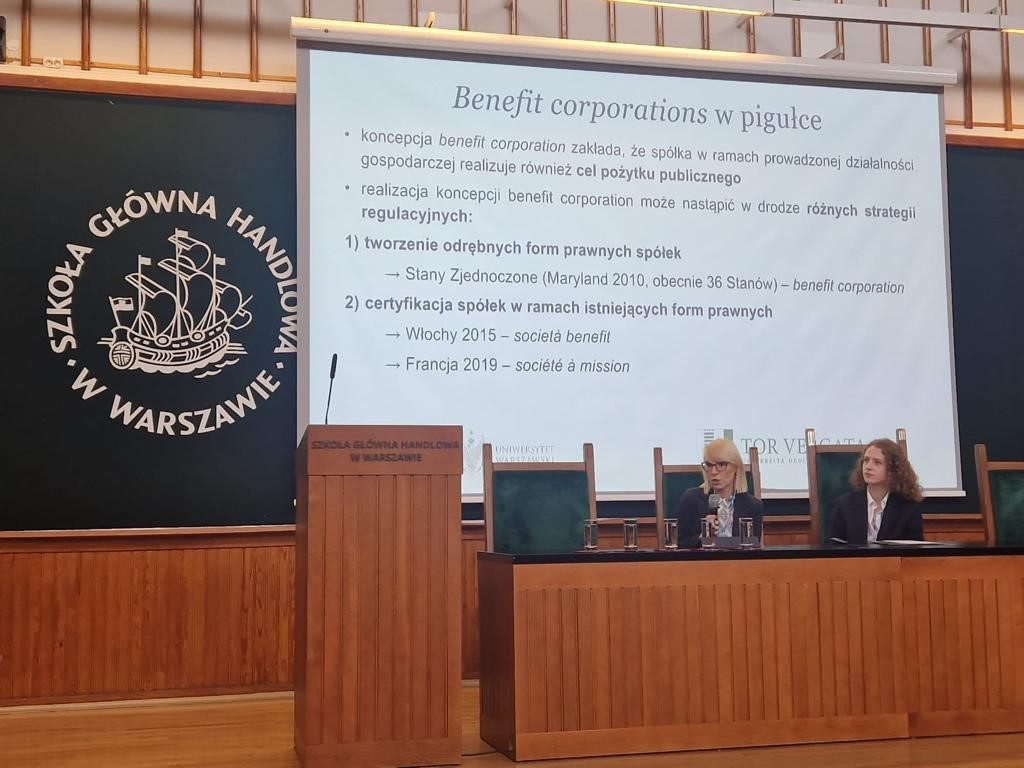
ESG Conference, SGH Warsaw School of Economics, 12 October 2023
On 12 October 2023, Zofia Mazur and Aleksandra Szczęsna participated in the conference "ESG – Sustainable transformation of the economy, local governments and financial markets – trends, challenges and best practices", organised at the SGH Warsaw School of Economics, and delivered a presentation entitled "Sustainable transformation of the economy and corporate governance - conclusions from research on the so-called benefit corporation".
- 06
2023 Annual Meeting of the European Corporate Governance Institute (ECGI), Copenhagen Business School, 20 September 2023
On 20 September 2023, Anne-Marie Weber presented the paper "Redefining the Corporate Purpose - The Influential Role of Academics" during the 2023 Annual Meeting of the European Corporate Governance Institute (ECGI), held at Copenhagen Business School.

Project team
 Project Leader
Dr Anne-Marie Weber
Anne-Marie Weber is an Assistant Professor in the Department of Commercial Law at the University of Warsaw, where she defended her doctoral dissertation, subsequently awarded by the Chairman of the Polish Financial Supervision Authority in a competition for the best doctoral thesis in financial market law and published as a monograph entitled "The Impact of Capital Market Legal Institutions on the Efficiency of State-Owned Companies". She holds an LL.M. degree from Berkeley School of Law. She teaches company law and financial market law and is a lecturer at the School of German Law at the Faculty of Law and Administration at the University of Warsaw. Dr Anne-Marie Weber is a frequent Visiting Scholar at the Max Planck Institute for Comparative and International Private Law in Hamburg. She has also served as a Visiting Professor at Berkeley School of Law and the University of Mainz. She has received numerous scholarships and research grants, including from the French government (Campus France), the Max Planck Gesellschaft, and the National Science Centre. Her habilitation thesis, currently in preparation, concerns the issue of implementing and enforcing climate policy objectives using private law institutions, primarily company law.

Dr Zofia Mazur
Zofia Mazur earned her PhD in Legal Sciences at the University of Rome "Tor Vergata". She completed her studies at the University of Turin and the University of Bologna, obtaining a bachelor's degree in Business and Public Administration Consultant (Bologna) and two master's degrees in Comparative Civil Law (Turin). She also completed the Institute of Legal Sciences of the Polish Academy of Sciences (Postgraduate Study of Competition Law). She was a visiting PhD candidate at the University of Paris Panthéon-Assas, and an intern at the Italian Competition Authority in Rome and the European Banking Authority in Paris. Currently, she is a Teaching Tutor at the University of Bologna (course: Antitrust in Financial and Insurance Sector) and an external legal consultant for the Italian Ministry of Enterprises and Made in Italy.

Aleksandra Szczęsna
Doctoral candidate at the Department of Commercial Law, Faculty of Law and Administration, University of Warsaw. Aleksandra Szczęsna graduated from the University of Warsaw and holds a Master's degree in Business Law with a specialisation in French and European business law from the University of Poitiers. In her professional and academic work, she focuses on the impact of technological development on various branches of law.