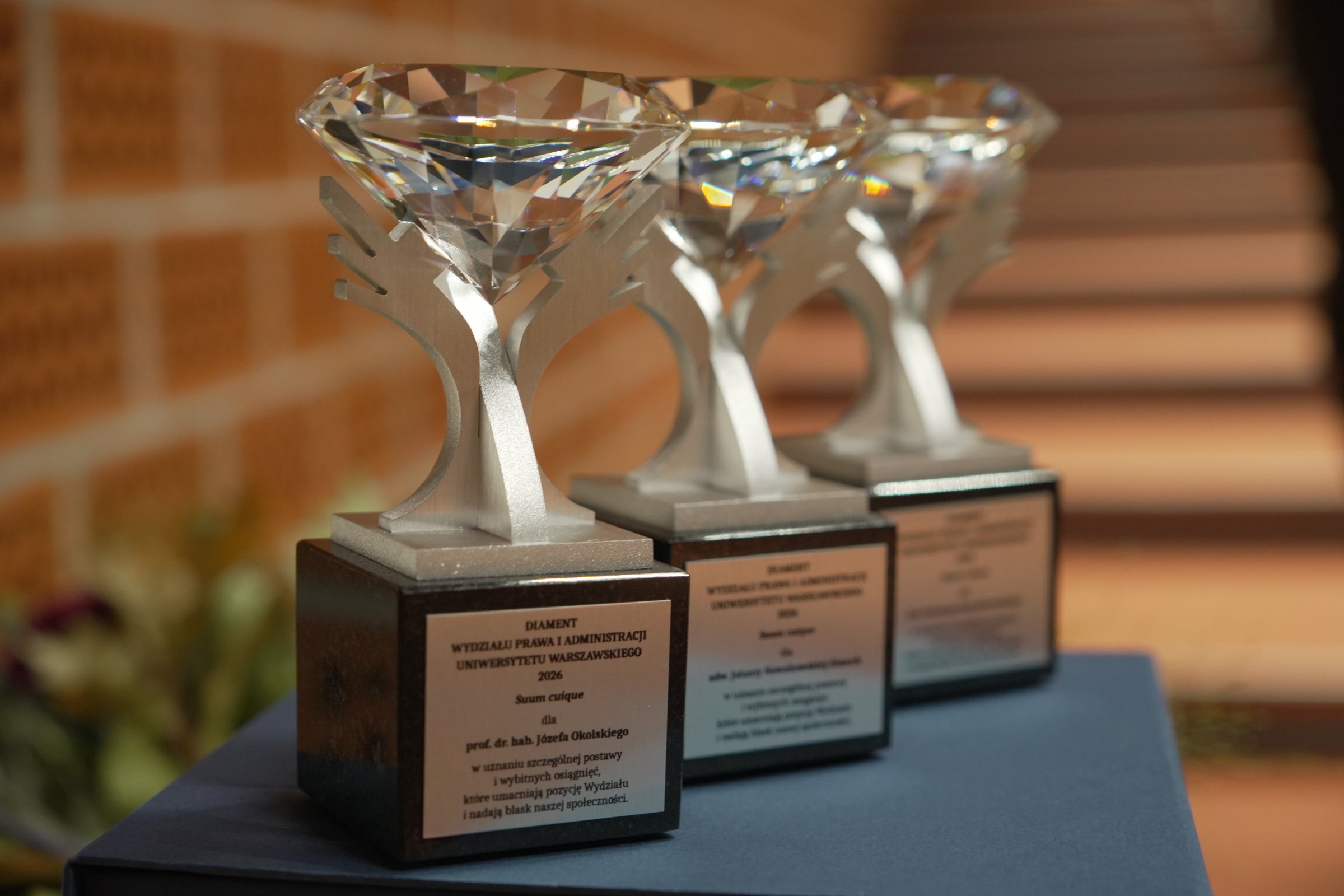
Three Paths, Common Roots. An Interview with the Laureates of the WPiA UW Diamonds 2026
An interview with attorney Jolanta Nowakowska-Zimoch, Professor Józef Okolski, and Dr. Cezary Stypułkowski.
What remains of studying at the Faculty of Law and Administration of the University of Warsaw after several decades? Memories of lecturers, of the first professional experiences; friendships that have stood the test of time also remain, and above all, the conviction that law can open the way to many different places. Prof. Dr. Hab. Józef Okolski, advocate Jolanta Nowakowska-Zimoch, and Dr. Cezary Stypułkowski, laureates of the Diamonds, spoke about their beginnings at the Faculty of Law and Administration, their professional choices, and the changes taking place in the legal profession at the ceremonial Faculty Council on September 25. Each of them connected their career with a different area. Prof. Józef Okolski developed academic and scientific activity at the Faculty for years, advocate Jolanta Nowakowska-Zimoch built a career in legal practice, and Dr. Cezary Stypułkowski linked his professional life with the world of finance and economy. However, something more than a diploma from the same university connects them. They remember the Faculty as a place that allowed them to develop their interests, meet people, and – as one of the laureates says – "find their way in life".
Is there a unique event in your memories that you particularly fondly recall from your student years?
Advocate Jolanta Nowakowska-Zimoch: I have many such memories. I fondly remember Dean Rezich. When I had a skiing accident during my studies and was in a cast for six months, I couldn't attend classes normally or study extramurally. However, the Dean allowed me to sit for exams without attending classes. This was a very important experience for me, as I then understood that I could choose subjects according to my own interests. And because I was interested in many things, I attended various unusual classes. One of these was my master's seminar. I was what was called a "floating master's student." I began my master's thesis with Professor Leśnodorski. Our conversations covered everything – from philosophy and history to the topic of my thesis. These were enriching, fantastic meetings. Later, due to his health, I was transferred to Professor Czachórski, who unfortunately also fell ill soon after. Ultimately, I wrote a thesis on public international law, concerning the law of the sea and the economic zone. I never pursued this professionally thereafter. By telling this story, I want to say that these studies were, for me, primarily a great opening to the world. Law is such a broad field that everyone can find their place in it. For me, studying was also a time of searching for my own path. Moreover, already in secondary school, I knew I wanted to become an advocate.
Prof. Okolski, and you? What memory from your studies and the beginning of your work at the Faculty do you particularly recall?
Prof. Józef Okolski: It is difficult to choose just one. I recall, for instance, a trip to London with Dean Weralski. We travelled by train through Kutno and Poznań, then through the Netherlands, and from there by ship to London. The students were very lively; Professor Piotr Kruszyński even sang, and Dean Weralski stated upon our return that he would never again go on any trip with students. Today, the world looks completely different – we fly to London, and many things can be done online. However, there is also another memory, perhaps more significant. I was once on Kasprowy Wierch with Professor Jerzy Rajski. We were skiing, and at one point the professor asked me if I would like to work at the University of Warsaw in the Department of Civil Law. I replied that I would. Prior to this, at the request of Professor Jerzy Jodłowski, I had been undertaking an internship at the Faculty. Soon after returning from the mountains, a meeting took place which included Leszek Falandysz, Grzegorz Domański, Józef Gajek, and myself. Falandysz went to the Institute of Criminal Law, while the others went to the Department of Civil Law. These were individuals who later profoundly influenced the development of the Faculty. Leszek Falandysz, Grzegorz Domański, and Józef Gajek are no longer living, but their legacy remains. Professor Rajski developed comparative law at the Faculty, Professor Marek Madey – economic and commercial law. I was fortunate to meet many outstanding professors and friends in my life. To a large extent, they shaped my professional life.
It is wonderful to hear that such strong friendships can be forged at our Faculty, friendships that are remembered years later. However, remaining for a moment longer in reminiscences and the beginnings of practising the profession; Esteemed Sirs/Madams, was it difficult to transition from the, shall we say, hothouse academic environment to actual practice?
Adv. Jolanta Nowakowska-Zimoch: Yes. Fortunately, after graduation, one had to complete a court traineeship. These were two years of very good, practical preparation for the profession. I received a distinction and an offer to become a criminal assessor, but I decided on an attorney's traineeship. President Wieczorek tried to persuade me not to reject the offer of an assessorship. However, I said that my dream was to become an attorney. I was then told that without a legal or attorney family, I had no chance of achieving this. As you can see, I succeeded nonetheless. The transition from theory to practice was, in fact, the greatest difficulty. At that time, the relationship between academia and the profession was much weaker than it is today. The University provided knowledge, and the traineeship taught the craft. I remember my first task with my patron. I was to prepare a draft decision on temporary arrest. I knew the legal basis, but I had never seen such a document before. This illustrates the difference between academic knowledge and practice. The legal profession requires continuous learning. The law changes very quickly, new regulations appear, and sometimes legislative chaos too. One must be able to make decisions and take responsibility for them.
Will the lawyer of the future then be needed? Today, one of the greatest challenges for lawyers is the development of artificial intelligence. Will AI change the industry?
Prof. Józef Okolski: The legal profession is very demanding, and as a result, it may be less attractive than it once was. Artificial intelligence is another factor that will influence its future. Already today, some activities that previously required the involvement of a lawyer can be performed online. Establishing a company also no longer has to look the way it used to. Dr Cezary Stypułkowski: The world is changing, and we must come to terms with it. Repetitive and mechanical tasks will be increasingly automated. This can be compared to the invention of the steam engine, which replaced some of the work previously performed by humans or animals. However, I do not view AI solely as a threat. I am rather an optimist. It can be a tool that facilitates work and allows a person to focus on what is more complex. Adw. Jolanta Nowakowska-Zimoch: For me, AI somewhat resembles the situation when computers and printers appeared. Suddenly, the possibilities for work greatly increased. It will be similar with AI, but one fundamental rule must be remembered: everything we receive must be checked, verified, and compared with sources. If a person unreflectively accepts a result generated by AI, they may make a mistake. On the other hand, if we treat this technology as a tool, we can free up our intellectual resources and devote more time to matters that truly require an individual approach. Law will still remain work with people. Emotions, the way of communicating, the reactions of the other person, generational differences – these all matter. This is precisely what makes a lawyer's work so fascinating.
Let us pause for a moment on the issue of new generations of lawyers, particularly female lawyers. I would like to know your assessment, from the perspective of many years of practice, regarding the situation of women in the industry.
Adv. Jolanta Nowakowska-Zimoch: It is very important to exchange experiences – both between women, and between women and men. Barriers have an external dimension, but also an internal one. And often, it is the latter that proves to be the most difficult. One must believe in their own capabilities. This does not, of course, mean feeling that everything is owed to us. One's position must be earned through work, knowledge, experience, and relationships with people. Prof. Józef Okolski: Women today constitute a very large part of the legal community and are excellently prepared. In many legal professions, they are exceptionally competent. Dr Cezary Stypułkowski: In professions where working with people is essential, women are increasingly taking up managerial positions. This is a natural consequence of their competence and their way of functioning within these environments.
What exactly does a legal education offer to a person who does not necessarily work in a court or a law firm later on?
Dr Cezary Stypułkowski: I am reminded of a saying by Professor Zygmunt Rybicki, the then Rector of the University of Warsaw. We once had joint seminars with students from the Faculty of Management. The Professor said then: “A lawyer is like a master key – they fit every door.” This is a very apt description. A legal education is universal. It allows one to find their place in the economy, as well as in public or social life. Lawyers also often have a certain ease in making contacts. They are able to find their way in various environments, and this skill is very valuable regardless of the career path we ultimately choose. Attorney Jolanta Nowakowska-Zimoch: The Faculty primarily gave me the ability to look at life from many perspectives. A person's interests can change, and it is precisely the versatility of law that allows them to develop. But people are the most important. Many graduates of the Faculty of Law and Administration at the University of Warsaw work at Greenberg Traurig law firm. This year we had around 600 candidates and most of the people we hired graduated from this very Faculty. The University of Warsaw is open and gives people the opportunity to find their own place.
Mr. President/CEO, your professional path led from law towards finance and economics. Why this direction?
Dr. Cezary Stypułkowski: I completed my studies in 1979. I received a blue diploma then. I took up my first job at the Faculty of Law and Administration of the University of Warsaw as an assistant, in the then Department of National Economy Management and Comparative Administrative Law. My supervisor was Professor Ludwik Bar, who became the head of a team in the Commission for Economic Reform, and together with him, I entered this environment. I worked, among others, with Professor Władysław Baka and Professor Zdzisław Sadowski. I was associated with the Faculty until 1988, and I defended my doctorate in 1989. Law and economics had interested me virtually since high school. I dedicated my matriculation essay to the energy crisis. However, I wanted to enter the world of finance. In the mid-1980s, I received a Fulbright scholarship and went to Columbia University Business School. In New York, for the first time, I truly encountered the world of finance. The lecturers were practitioners from Wall Street, and I also completed internships at Chemical Bank, Dillon Read, and Citibank. In a sense, it was a continuation of interests that had emerged earlier. My mother also started her first job at a bank.
If you were to offer one most important piece of advice to current students, what would it be?
Dr Cezary Stypułkowski: I believe there are two fundamental things. Firstly, one must continuously strive to learn. Curiosity about the world and determination in acquiring knowledge are extremely important. Secondly, over time, knowledge alone ceases to be sufficient. At the beginning of one's professional career, it is a key factor for success, but later, character, experience, the ability to collaborate with people, and relationship-building become increasingly significant. One does not need to be liked by everyone. However, one must be predictable, reliable, and trustworthy. Long-term professional success is a combination of competence and maturity. It is worthwhile to maintain individualism, but it should not be mistaken for arrogance or acting in a way that destroys team energy. Ultimately, a lasting position is determined by a combination of knowledge, experience, and character.
Finally, we would like to ask, what does receiving the Faculty Diamond statue mean to you?
Dr Cezary Stypułkowski: This distinction was a huge surprise for me. And perhaps it moved me more than many other awards I have received in my life. There is something special about it, because the award comes from an environment with which I have been associated almost from the very beginning of my journey. The current deans and representatives of the faculty authorities are people of my son's generation. I was all the more surprised to have been noticed. I understand, of course, that my professional experiences may have provided some inspiration. They show that after completing a law degree, one does not have to pursue only a classic legal profession. One can find their place in other areas and successfully build a career. I must admit that I boasted a lot about this award. Also on social media. Attorney Jolanta Nowakowska-Zimoch: For me, it was also a complete surprise and a great emotional moment. I would like to thank the Faculty Council and all those who were present during the ceremony. This is probably one of the most important distinctions I have received in my professional life. It is not every day that one has the opportunity to return to their alma mater under such circumstances. Prof. Józef Okolski: I am glad that the Faculty remembers me. I spent a significant part of my life here. I am proud that I was able to co-create the Faculty of Law and Administration and participate in its development. Such a Diamond is a sign for me that I left behind some trace, which has been noticed and appreciated by successive generations. It is a very pleasant feeling. And I am very happy that I could meet with the Faculty again.
We thank you for the conversation and for accepting the WPiA UW Diamonds. This distinction is not only an expression of appreciation for your journey to date, but also a reminder that the bond with the Faculty can last long after graduation. We hope that there will be many more opportunities for further meetings.
Interview conducted by Sekcję Promocji WPiA UW.